Some employee benefits advisors offer self-funding as a health plan option for smaller employers, but they rarely lead with it. Fully insured health plans are often viewed as the norm, while self-funded options may be presented as a higher-risk alternative. As employers become increasingly dissatisfied with traditional health plan options, brokers may want to rethink how and when they introduce self-funding.
How You Frame Self-Funding Matters
 The way you introduce an alternative health plan can determine whether the employer keeps listening.
Self-funding is often associated with large employers with the resources necessary to tolerate a high level of risk. Smaller employers may assume that self-funding arrangements aren’t viable for organizations their size, and the way brokers frame the options may reinforce this perception.
But times have changed. The right self-funding options can work for smaller organizations with as few as 50 or even 20 employees. Although self-funding isn’t a good fit for all employers, it can be a game changer for the right organizations. Unfortunately, many employers dismiss the strategy, even when it’s offered to them, and brokers sometimes inadvertently contribute to this.
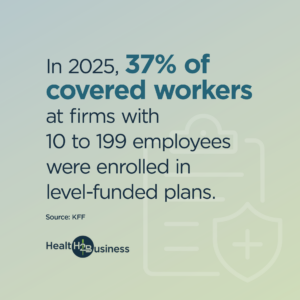
The market is already moving in this direction. In 2025, 37% of covered workers at firms with 10 to 199 employees were enrolled in level-funded plans, according to KFF.
A typical interaction goes something like this:
- An employer is hit with a rate increase or unfavorable changes to coverage and asks about alternative plan options.
- The broker presents a spreadsheet that shows how different fully insured plans compare. None of them stand out as a good fit.
- The broker asks if the employer has ever considered self-funding. The employer responds negatively because it seems too risky, so the broker drops the subject.
- The employer picks the plan option that sucks the least. In a year or two, the entire process is repeated.
Self-funding is never really discussed because the employer doesn’t seem interested, but the employer isn’t interested because of common misconceptions. If the broker can address those misconceptions, the conversation may change.
There’s More to Self-Funding Than Funding
Conversations about self-funding tend to focus on the funding aspect. It makes sense – it’s right there in the name. However, the funding arrangement is only one aspect of what employers should consider.
The term “self-funded” tells you how the health plan is funded. It doesn’t tell you why it’s funded this way. Smaller employers often focus on the risk and responsibility rather than the opportunities.
Employers that embrace self-funding understand that being the payer comes with benefits. When you pay the claims, you can gain greater access to claims data and greater control over the plan design. You can leverage insights to build a plan that balances great care with cost control. You can also use outside-the-box strategies, like contracting directly with community healthcare providers instead of relying exclusively on traditional networks.
And it’s not necessarily as risky as some smaller employers assume. With stop-loss coverage, including arrangements that may incorporate a captive, employers can limit their exposure to unexpectedly high claims while retaining many of the advantages of self-funding. The challenge is getting employers to consider self-funding with an open mind.
Three Ways to Change the Conversation
If your business clients tend to dismiss self-funding without much consideration, the problem may come down to how you’re presenting it.
- Fill in any knowledge gaps. Brokers can have misconceptions about self-funding, too. If you view it as a risky option that’s only suitable for Fortune 500 companies, your clients may pick up on this. Take some time to learn about self-funding and direct plan options so you can advise your clients successfully.
- Introduce self-funding early. If you’re presenting self-funding as a last-ditch effort for employers with no other options, your clients may not want to pursue the strategy. Consider presenting self-funding early on, alongside traditional fully insured plan options so your clients can compare the two strategies.
- Establish the potential advantages. Employers need to understand the downsides of self-funding before they take on this strategy. However, if you lead with the downsides, you may never get a chance to explore the advantages.
Whether or not it’s intentional, the questions you ask can shape the employer’s response:
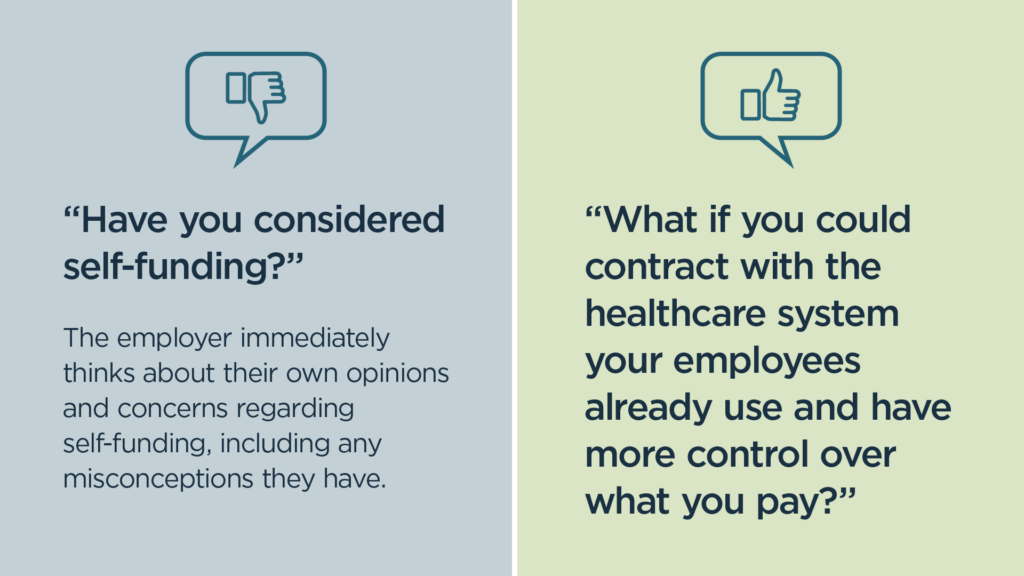
You ask, “Have you considered self-funding?” The employer immediately thinks about their own opinions and concerns regarding self-funding, including any misconceptions they have. A negative answer can shut down the conversation before it begins.
You ask, “What if you could contract with the healthcare system your employees already use and have more control over what you pay?” This piques the employer’s interest, allowing you to explain how self-funding makes it possible. If the employer is interested, you can have a serious conversation about the pros and cons.
Help Clients Explore More Sustainable Options
Employee benefits brokers are in a difficult position right now. Healthcare costs keep rising, and many employers are realizing that the current cost hikes are unsustainable. When traditional options no longer meet a client’s needs, brokers who can introduce and explain alternative strategies have an opportunity to demonstrate their value as advisers.
Health2Business helps self-funded employers contract directly with community healthcare providers. Learn how brokers can stand out by offering self-funded direct healthcare plans.