Health plan data can tell you a lot, but only if you have access to it and know how to use it. With the right information, employers can identify cost drivers and make meaningful changes to control costs. However, fully insured employers often lack access to this information, making it harder to understand what’s driving healthcare costs and where opportunities for savings may exist.
Access to Health Plan Data Is an Overlooked Differentiator
When employers compare their fully insured, level-funded and self-insured health plan options, they often focus on costs. Access to health plan claims data also deserves attention.
You’ve probably heard the saying, “Knowledge is power.” When it comes to controlling healthcare spending, this is especially relevant. Employers want to know how to lower healthcare costs, and the answers can often be found in their claims data. Whether or not you’ll see this data largely depends on the type of health plan you use.
Fully insured health plans may not offer any access to claims data, while self-funded health plans may offer insightful access to claims data.
What Can Health Plan Data Tell You?
The value of health plan data comes from the ability to use that information to make better decisions about plan design, benefits and spending. If you ask the right questions, health plan data can provide significant insights.
Questions to ask include:
- What percentage of healthcare spending goes to pharmacy costs compared with medical costs?
- Has pharmacy spending increased, and if so, by how much?
- What’s driving pharmacy costs: expensive specialty drugs or high-demand drugs like GLP-1 medications?
- Are plan members using brand-name prescriptions when less expensive generic options are available?
- How frequently are employees using emergency rooms and other high-cost healthcare settings?
- What are the primary drivers of medical spending?
- How are utilization patterns changing?
The goal is twofold. You want to know where your healthcare dollars are going now. You also want to know how your spending is changing so you can better plan for future costs.
Identifying Opportunities to Control Costs
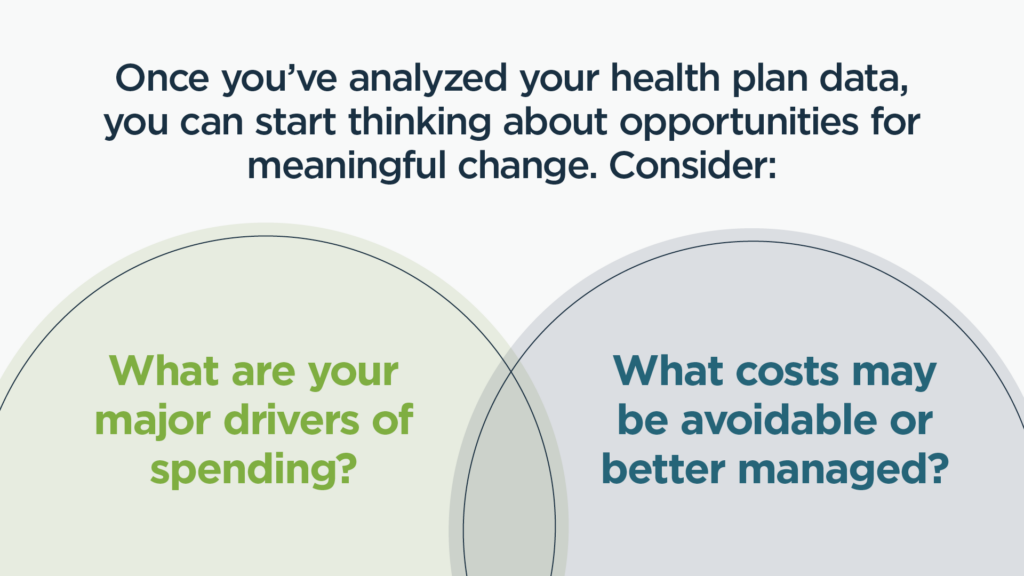
Once you’ve analyzed your health plan data, you can start thinking about opportunities for meaningful change. Consider:
- What are your major drivers of spending?
- What costs may be avoidable or better managed?
You’re looking for overlap here: major drivers of spending where targeted changes could improve efficiency without sacrificing access to quality care. For example, if emergency room utilization is increasing for minor health conditions, you may be able to reduce costs by encouraging less expensive care options. If plan members are using expensive brand-name prescriptions when generic options are available, you may be able to reduce costs by helping members identify lower-cost generic options when appropriate.
Turning Health Plan Data into Action
The next step requires targeted initiatives designed to manage costs. These initiatives can take the form of plan design tweaks or new services or programs. Although the initiatives you should start with will depend on what you’ve learned from your claims data, here are some examples of what’s possible:
- Offer services to help plan members navigate complex health conditions, such as pregnancy, diabetes, heart disease and cancer. Plan members dealing with complex care needs may struggle to find the care they need. As a result, they may end up missing important care, triggering more expensive claims down the road, or they may choose unnecessarily expensive care options. By helping these members navigate their care needs, health plans can support well-being while controlling long-term costs.
- Negotiate access to high-demand prescriptions at an affordable price. GLP-1 medications are a prime example. If you can negotiate an affordable cost through a pharmacy benefits manager or other program, you can give your plan members the coverage they want while controlling costs.
- Offer and promote telehealth options. If plan members are using high-cost urgent care or emergency care providers for minor health issues, you may be able to lower costs by encouraging cost-effective telehealth services. You can steer plan members toward affordable options by offering a low or $0 copay.
- Require prior authorization for certain medications or services. If you’ve noticed high utilization of medications or services that are not always medically necessary or that have more cost-effective alternatives, prior authorization may help control costs. You may also be able to create corequisites for certain types of care, such as requiring participation in a weight management program for anyone who wants GLP-1 medications for weight loss.
- Use tiered prescription drug formularies. Tiered pricing can be an effective way of steering plan members toward more cost-effective options while still providing some coverage for other medications.
Taking Control of Healthcare Costs
Rising healthcare costs continue to create challenges for employers and their workers. Gaining greater visibility into what’s driving these costs is an important first step, but the real value comes from turning insights into action.
Health2Business helps self-funded employers take control of healthcare spending with innovative solutions. Our direct partnership model facilitates mutually beneficial contracts between employers and community healthcare providers.
Employers who adopt the H2B model see average first-year premium savings of 24% with average premium increases of just 1.9% in years two through four. Additionally, employees see a 90% reduction in out-of-pocket costs on average. See how H2B helps employers take control of costs and coverage.